
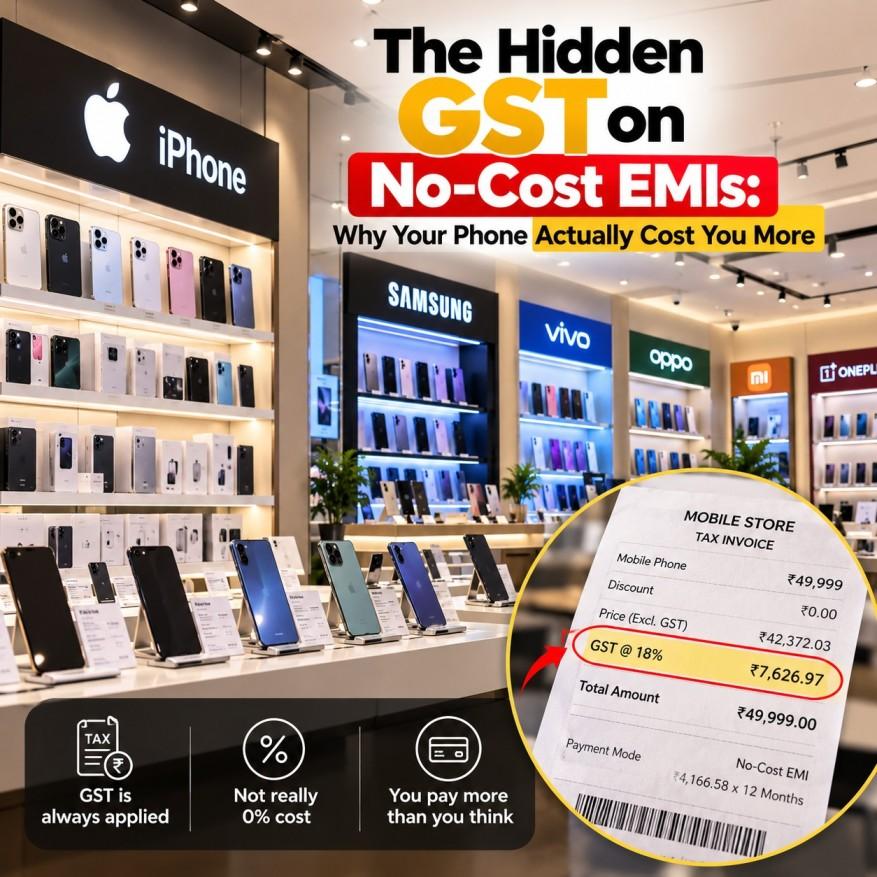
No-Cost EMI Isn’t Really Free: The Hidden GST Charges That Make Your Phone More Expensive

Buying a new smartphone has become easier with online shopping, festive discounts, bank offers, and flexible payment options. One of the most popular offers is No-Cost EMI, which allows customers to purchase an expensive phone and pay for it in monthly instalments instead of making the full payment upfront.
At first glance, No-Cost EMI sounds like a perfect deal. You get the smartphone you want, spread the cost over several months, and avoid paying traditional interest separately. However, the actual cost of your purchase may be higher than you expect.
The reason is that No-Cost EMI offers can involve GST on interest-related charges, processing fees, and other applicable costs. In addition, customers may sometimes lose an upfront discount when choosing an EMI option.
Understanding these hidden costs is important before purchasing a smartphone. In this guide, we will explain how GST on No-Cost EMI works, why your phone may cost more than expected, and how to check whether an EMI offer is genuinely worth it.
What Is No-Cost EMI?
No-Cost EMI is a payment option that allows customers to divide the purchase price of a product into equal monthly instalments without paying an additional interest amount directly, as advertised.
This option is commonly available when buying smartphones, laptops, televisions, home appliances, and other expensive products.
For example, suppose you want to purchase a smartphone worth ₹60,000. Instead of paying the entire amount immediately, you can choose a 12-month No-Cost EMI plan and pay ₹5,000 per month, subject to the offer's terms.
However, the absence of a separately charged interest amount does not necessarily mean that the entire transaction is free of additional costs.
Depending on the offer, the effective interest may be offset through a discount, a bank or merchant subsidy, or another pricing arrangement. Processing fees and applicable GST may still increase your overall expenditure.
How Does GST Apply to No-Cost EMI?
GST, or Goods and Services Tax, is an indirect tax charged on eligible goods and services in India. When purchasing a smartphone, GST is generally included in the product's selling price.
However, another GST-related cost may arise from the financing arrangement.
If a lender charges interest or a processing fee that is subject to GST, the applicable tax may be added to that charge. The exact amount depends on the financing structure and the lender's terms.
For example, certain loan-processing services attract GST at 18%. If your lender charges a processing fee of ₹500 plus 18% GST, the additional tax would be ₹90, making the total fee ₹590.
It is important to understand that GST is not automatically charged on every amount associated with every No-Cost EMI offer. The treatment depends on the nature of the charge. Interest on qualifying loan transactions may be exempt from GST, subject to applicable conditions, while separate processing or service fees may attract GST.
Therefore, customers should check the lender's fee schedule and the invoice or loan statement instead of assuming that GST applies to the entire EMI amount.
The Hidden Charges That Can Make Your Phone More Expensive
1. GST on Processing Fees
Some banks and financial institutions charge a processing fee for arranging an EMI facility. Depending on the offer, this fee may be a fixed amount or a percentage of the transaction value.
GST may be applicable to this service charge.
For instance, if the processing fee is ₹499 and GST at 18% applies, the tax would be approximately ₹90. The total processing cost would be around ₹589.
Although this amount may seem small compared with the smartphone's price, it increases your actual purchase expenditure.
2. Interest-Related Charges
Some No-Cost EMI offers are structured so that the interest cost is offset by an upfront discount or a subsidy from the seller, brand, or another party.
In such cases, the customer may not pay the advertised interest separately, but the financing arrangement can still affect the final price.
Where a separate taxable service charge is collected, GST may apply to that charge. The tax treatment of interest itself is different from the treatment of processing fees and other services.
This is why customers should review the complete cost breakdown rather than relying only on the phrase "No-Cost EMI."
3. Discount Loss on EMI Purchases
One of the most overlooked costs is the discount you may lose by choosing EMI.
Suppose a smartphone is listed at ₹60,000, but the seller offers a ₹3,000 discount for an upfront payment. If that discount is unavailable on No-Cost EMI, your effective upfront price would be ₹57,000, while the EMI purchase could remain at ₹60,000 before any additional charges.
In this situation, the difference is ₹3,000, even if the EMI instalments appear interest-free.
Always compare the final payable amount under both payment options before deciding.
4. Bank and Platform Fees
Online marketplaces, banks, and financing partners may have different terms for EMI transactions.
Depending on the specific offer, additional costs may include:
-
EMI processing fees
-
Applicable GST on service fees
-
Foreclosure or prepayment charges, where permitted and applicable
-
Late-payment charges
-
Other disclosed financing-related fees
Not every offer includes all these charges. Some promotions waive processing fees or offer additional discounts to eligible customers.
Read the terms and conditions carefully to identify which costs apply to your particular transaction.
5. Credit Card EMI Conversion Charges
Customers who convert a credit card purchase into EMI may face a different fee structure from those using a merchant's No-Cost EMI offer.
The bank may charge a processing fee or other applicable charges when converting the transaction into instalments. GST may be added to eligible service fees.
In some cases, a purchase advertised as No-Cost EMI may still involve charges that are not immediately obvious on the product page.
Check the card issuer's EMI terms and the final transaction details before confirming the purchase.
Example: Comparing No-Cost EMI With an Upfront Payment
Consider a smartphone priced at ₹60,000 with a ₹3,000 discount available on an upfront payment.
| Purchase Detail | Amount |
|---|---|
| Smartphone price | ₹60,000 |
| Discount on upfront payment | ₹3,000 |
| Effective upfront purchase price | ₹57,000 |
| Total scheduled No-Cost EMI payments | ₹60,000 |
| Difference before additional fees | ₹3,000 |
In this example, choosing No-Cost EMI means paying ₹3,000 more than the discounted upfront price, even before accounting for any applicable processing fees or GST.
This does not mean that every No-Cost EMI offer is more expensive. If the EMI offer includes an equivalent discount, has no processing fee, and does not introduce other costs, it may be a reasonable option.
The key is to compare the actual final cost rather than the advertised monthly instalment.
How to Calculate the Real Cost of No-Cost EMI
Before purchasing a smartphone, use the following simple method to compare payment options.
Step 1: Check the final upfront price.
Subtract



No comments yet. Be the first to comment!